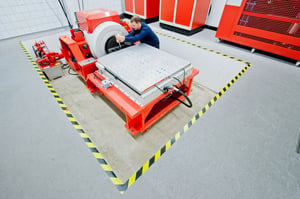
Vibration testing is a method to evaluate a product's ability to endure mechanical vibrations, simulating conditions during transportation, machinery operation, or environmental factors. The product is securely mounted on a vibration table or shaker, and mechanical vibrations are applied with specific parameters.
Vibrations from a ship’s engine or from driving a vehicle on a rugged terrain are examples of events that cause fatigue and failure in mechanical and electrical systems.
When is a product likely to be subject to vibration?
- Routine shipping and handling
- Transportation
- Mounting of equipment on a ship’s bulkhead, in mechanical contact with engines, etc.
- Normal operational environments of ground vehicles and aircrafts
What type of equipment is used for vibration testing?
Nemko’s vibration testing facilities contain three electrodynamic shakers. The largest of these provides a continuous force in excess of 105 kN for the most used vibration testing events, sine and random vibration analysis.
We can combine several systems in the vibration testing to simulate your anticipated vibration conditions, such as mechanical vibration combined with various climatic conditions.
What standards and tests are used in vibration testing?
The effects of vibration over a wide range of frequency and acceleration levels can be simulated according to IEC 60068-series.
Non-exhaustive scope:
- IEC 60068-2-6
- IEC 60068-2-64
- IEC 60945
- Maritime Classification Society specifications
- Offshore
- Subsea
- Medical equipment
- Railway
- Other
Tests:
- Sinusoidal vibration
- Random vibration
- Sine on random vibration
- Combined vibration with cold/heat/humidity
Specifications:
- Frequency range: DC-2700Hz
- Max sine force: 105 kN
- Max accelaration: 150g
- Max weight: 1000 kg