




Hazloc North America
Navigating the complex landscape of North American hazardous location certification is critical for businesses aiming to ensure safety and compliance in environments where explosive atmospheres may occur. Understanding the standards, systems, and classifications involved in hazardous location (HazLoc) certification can significantly impact the safe operation and market approval of products.

Overview of Hazardous Location Certification
Hazardous locations are defined by areas where fire or explosion hazards may exist due to the presence of flammable gases, vapors, dusts, or fibers. These locations are rigorously assessed and classified based on the likelihood of these hazardous elements being present. In North America, two main classification systems are used: the Class and Division system and the Zone system, with the latter being prevalent in Canada for new installations.
Certification for hazardous locations involves evaluating and testing products to meet specific safety standards. This process is governed by detailed procedures developed and overseen by industry and agency safety leaders who participate actively in standards writing committees. The certification assesses both ordinary location requirements—addressing general safety concerns such as shock and fire—and hazardous location requirements, which focus on explosion protection based on the classified area's characteristics.
Certification Process and Compliance
To achieve certification, products must undergo rigorous testing against relevant standards and are often required to be inspected by approved testing bodies. These bodies ensure compliance with both national and international safety standards, including specific tests for explosion protection methods and general industrial safety standards. Regular production control inspections are mandated to uphold safety and compliance, adhering to standards set by the Occupational Safety and Health Administration (OSHA) and the Standards Council of Canada (SCC).
For new entrants to the North American market or those transitioning from different regulatory environments, beginning with a design review can save considerable time and resources. This ensures the product design meets specific requirements before undergoing the certification process.
Essential Safety Measures and Market Access
Proving electrical safety is an essential component of accessing the U.S. and Canadian markets. Products must satisfy federal safety requirements to be legally sold and operated in these regions. Ordinary Location/Safe Area Requirements apply to all electrical products risks associated with shock, fire and personal injury. This approval is known as a Nationally Recognized Testing Laboratory (NRTL) as defined by the Occupational Safety and Health Administration (OSHA). Most electrically powered devices used in the home or workplace must display an NRTL mark such as the Nemko mark, UL or CSA. In addition to the mandatory safety tests, ongoing factory production controls and quality management system inspections are crucial for maintaining certification.
Hazardous location certification also covered by the NRTL mark also includes additional safety measures, such as field labeling and factory inspections, to ensure that the equipment used in these dangerous settings does not become a source of ignition.
Classification of Hazardous locations
- by type
- by conditions
- by nature of the hazardous substance or material
TYPES
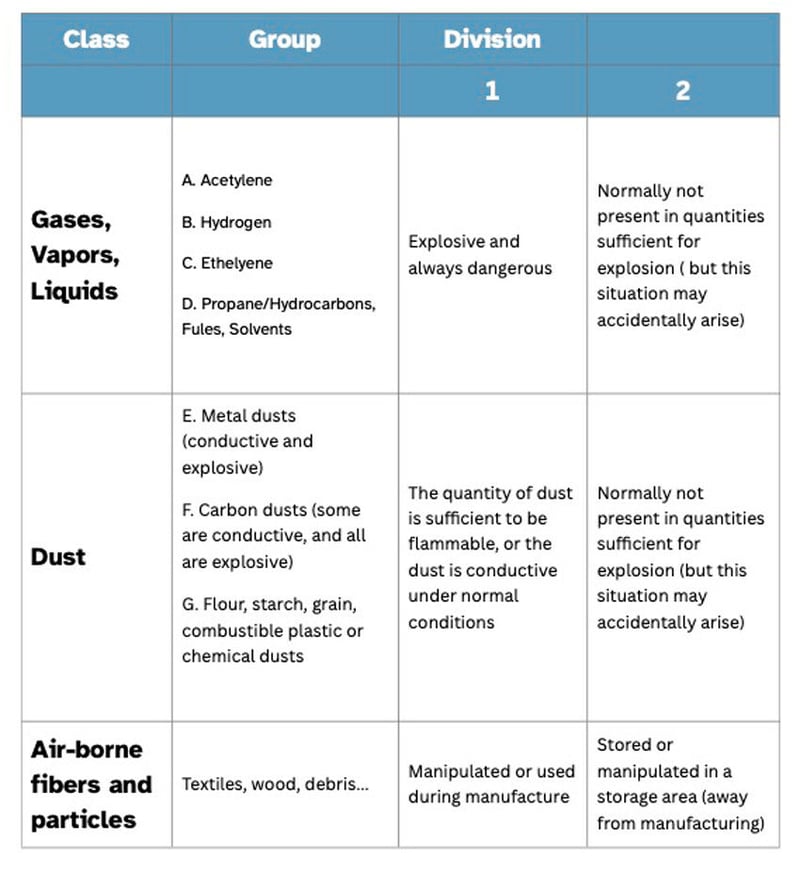
Hazardous environments are divided into three classes:
- Class I: designates a space that has become dangerous because of the possible presence of certain gases or vapors in sufficient quantity to be potentially flammable or explosive. Examples: petroleum refineries, gas distribution zones, spray finishing zones...
- Class II: designates a space that has become dangerous because of the presence of flammable air-borne dust. Examples: grain silos, manufacturers of plastics, aluminum, pharmaceutical products and fireworks...
- Class III: designates a space in which airborne fibers and particles can accumulate around a machine or on lighting equipment and become ignited by heat, a spark or a hot metal. Examples: textile factories, flax processing plants, factories that produce wood shavings or flying particles.
CONDITIONS
There are two types of conditions:
Division 1 (average conditions): the risk is present during regular production operations, or during ongoing repair or maintenance operations.
Division 2 (unusual conditions): the dangerous substance is only present in the case of an accidental break or defective functioning.
NATURE OF THE HAZARDOUS SUBSTANCE OR MATERIAL
The gases and vapors of class I hazardous environments are divided into four groups: A, B, C and D (these substances are grouped according to their combustion temperature, their explosion pressure and other combustion characteristics).
The dangerous substances of class II hazardous environments are divided into three groups: E, F and G (these substances are grouped according to their combustion temperature and their conductivity). Conductivity relates particularly to metal dusts.
Classification of Zones
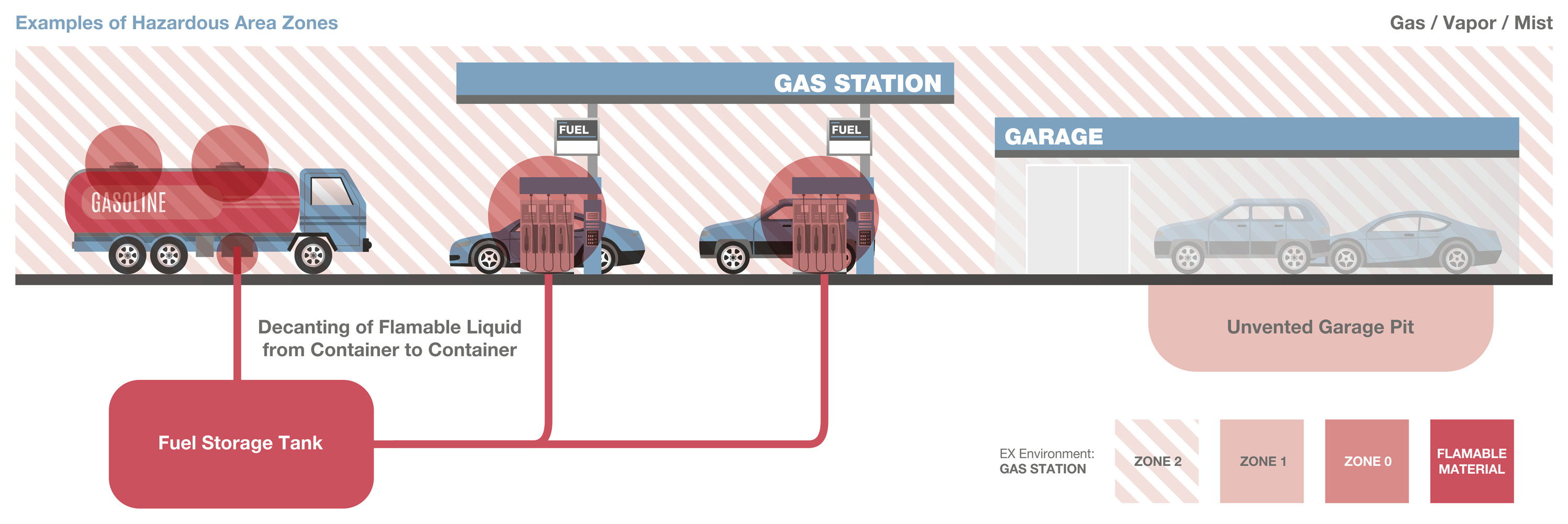
Areas where the Explosive Atmosphere condition is always present is classified as Zone 0 for Gases and Zone 20 for Dust. Areas where the Explosive Atmoshpere condition is present regularly is classified as Zone 1 for Gases and Zone 21 for Dust. Explosive Atmoshere condition which is rarely present is Zone 2 for gas and Zone 22 for Dust.
Conclusion
Understanding and adhering to the hazardous location certification standards is essential for manufacturers and businesses aiming to ensure safety and compliance while accessing North American markets. Compliance with these rigorous standards not only protects facilities and workers but also aligns with legal and operational requirements across the continent.

Compliance made clear
Compliance requirements can slow progress and create unnecessary risk. Nemko integrates compliance into the product development process to help teams reduce rework, simplify approvals, and move products to market with confidence.





Why choose Nemko?
Our team is ready to help with testing, certification, inspection and professional expertise for your automotive products.